
Anyone who moves into a tower here gets the same advice, usually from someone who has been in the city a lot longer. Take a high floor and you won’t get mosquitoes. It sounds right. Mosquitoes are small, the wind at sixty metres is rough on small flying things, and the nearest standing water is a long way down.
Then one evening in October you slide the balcony door open, and twenty minutes later something is biting your ankle on the thirty-first floor.
The advice isn’t wrong, exactly. It just rests on evidence that stops applying somewhere around the second storey, and nobody ever mentions where the cut-off sits or why.
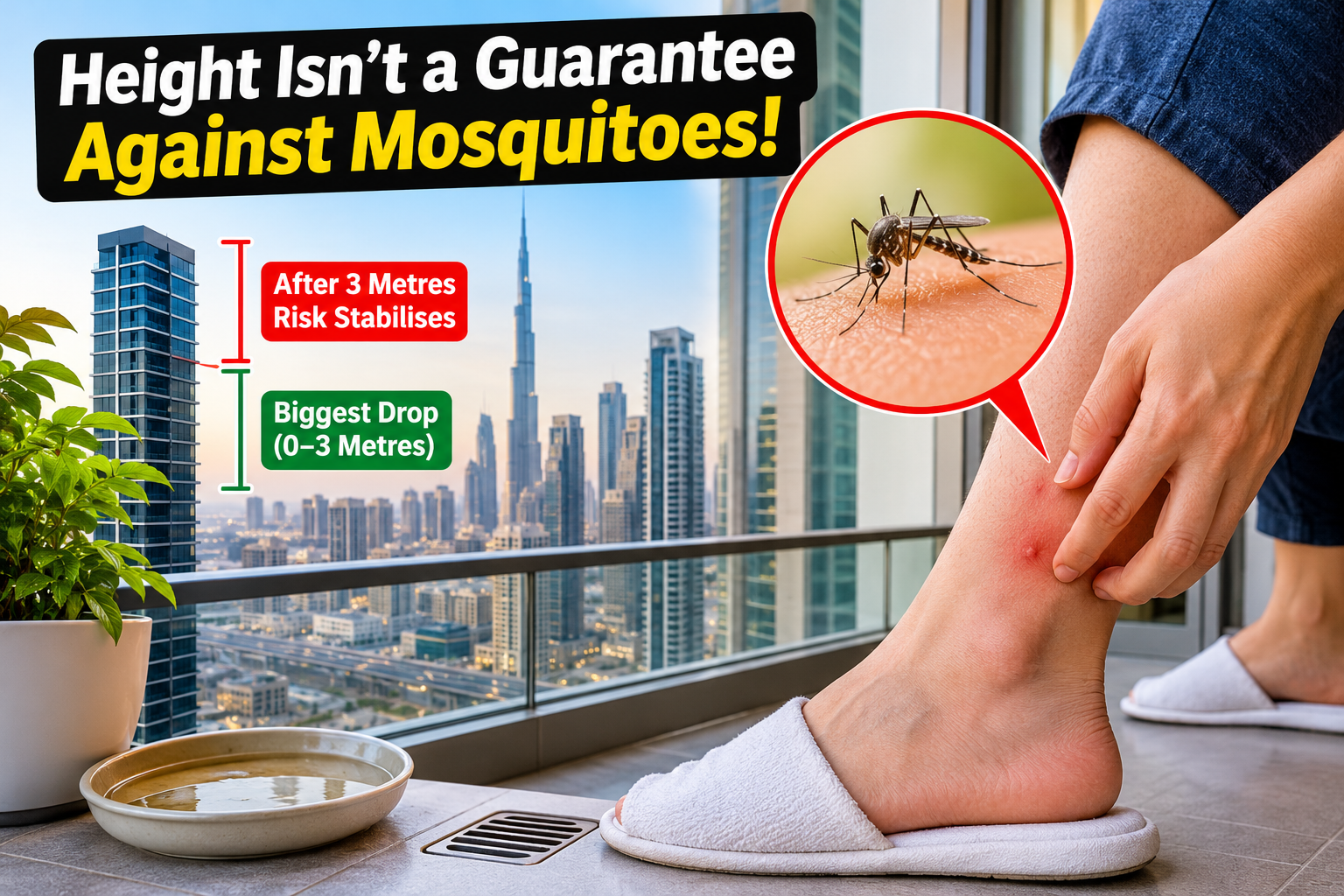
Height protects you, but only for the first three metres
There is a tidy experiment on this. A team working in rural Gambia built a hut on an adjustable platform and raised it to four heights: ground level, one metre, two metres and three metres. The hut sat at each height for ten nights across a forty-night run, and they counted whatever got inside.
At three metres above the ground, 84% fewer malaria mosquitoes entered the building than at ground level. The work came out in the Journal of the Royal Society Interface in 2021.
Three metres is roughly one storey. So the biggest single gain in the whole height question happens between the pavement and the first floor, before you have even reached the lift. What goes on above that is a separate matter, and the Gambia hut was never built to answer it.
What happens above the third floor is not what people expect
For that you want a study done in a tower rather than a field. A group in downtown Shanghai sampled multi-storey residential buildings for Aedes albopictus, with traps running as high as an eighth-floor terrace at one of the sites. One of their methods was the human landing catch, where a person sits still for thirty minutes and counts whatever lands on them. Those counts ran from the ground floor up to the sixth.
Mosquitoes caught per thirty minutes:
- Ground floor: 5.04
- Second floor: 0.13
- Third floor: 0.29
- Fourth floor: 0.58
- Fifth floor: 0.79
- Sixth floor: 1.50
Read that column twice. The fall from the ground to the second floor is enormous, which is exactly what the Gambia hut predicts. Then it turns around. By the sixth floor more mosquitoes were landing than on the second, and the authors found no statistically significant difference between any of the floors above ground level. The line drops off a cliff, flattens out, and starts creeping back up.
Worth saying plainly: different species, different climate. Aedes albopictus was not among the ten species recorded in the UAE survey below. What carries over isn’t the raw count, it’s the shape of the line. Height buys you a great deal straight away, then stops buying you anything.
Which mosquitoes the UAE actually has
A survey published in Parasites & Vectors in 2019 trapped across three very different sites in the Emirates: the brackish wetland at Ras Al Khor, the man-made ponds and containers of Al Ain Zoo, and the natural streams and rock pools of Wadi Wurayah. It turned up ten species.
Culex perexiguus dominated, with 710 specimens, making up 89.7% of everything caught at Al Ain Zoo. Aedes caspius came second on 287, concentrated at Ras Al Khor where salt-tolerant larvae do well. Culex quinquefasciatus accounted for 82.
One number in that paper matters more than the species list. Light traps at Al Ain Zoo pulled 116.6 mosquitoes per trap-night. The same traps managed 42.3 at Ras Al Khor and 3.8 at Wadi Wurayah. The richest mosquito site in the entire survey was the built one, full of concrete ponds and what the authors describe as numerous artificial containers.
That is the part to carry upstairs with you. The mosquito most likely to bite you in Dubai is a Culex, and Culex perexiguus larvae, in the paper’s own words, use a wide range of stagnant water sources. That doesn’t mean a marsh. It means any water that sits still long enough.
The breeding site is usually the building
A Culex female needs somewhere to lay that will stay wet and undisturbed for about a week. A residential tower offers more options than you would think, and none of them are at street level:
- Balcony floor drains that have silted up and now hold a shallow pool
- Saucers under planters, and the gravel trays beneath them
- Air-conditioning condensate sitting in a tray or backing up in a blocked line
- Unused floor traps in guest bathrooms and laundry rooms, where the seal water sits for months
- Flat roof areas, plant rooms and service decks after a wash-down or a rare rain
- Ornamental water features and irrigation pooling in a podium garden eight floors up
That survey didn’t test individual apartment buildings, because that isn’t what it set out to do. But the habitat it documents is the habitat your building provides. A mosquito that hatched on the twenty-eighth floor never flew up from the desert. It was never near the street at all.
And the lift is a vertical shortcut
The Shanghai team were careful about this. They say outright that their work does not prove mosquitoes reach particular floors by flying there. One alternative they put forward is that the frequent use of elevators may have carried the mosquitoes up into the high-rise floors.
It is an unglamorous explanation and a very plausible one. A lift car is a warm, enclosed, carbon-dioxide-rich box that covers forty floors in under a minute and opens its doors at both ends of the trip. Service risers, basement car parks and kitchen extract shafts offer the same sheltered vertical route, well out of the wind that is meant to be protecting you.
Why treating the ground floor does not fix your floor
This is where the two findings add up to something you can act on.
If the water that produced your mosquito is on your floor or the one below it, and if the ones that did come from downstairs took the lift, then a ground-level fogging programme is treating somewhere the insect was never in. Building management can do everything correctly at podium level and a flat on the thirtieth floor will notice no difference at all.
It also explains the seasonal confusion. People report the problem starting in autumn and assume something outdoors has changed. Usually what changed is that the weather got pleasant enough to leave the balcony door open after dark.
What actually works at an apartment opening
Three approaches, in order of how long the effect lasts.
Get rid of the standing water on your own floor. It costs nothing, and it is the only measure that reduces the number of mosquitoes instead of moving them around. Empty planter saucers once a week. Pour a jug of water down floor traps you never use, so the seal holds. Check that the balcony drain actually drains, and that the AC condensate line is clear. A week of neglect is about one generation.
Close the opening you actually use. In a Dubai flat that is almost always the balcony slider. It is the biggest gap in the whole building envelope, it is open exactly during the evening hours when Culex is active, and no amount of height does anything about it. A framed mesh panel running on its own track beside the glass is the usual answer, because it matches the way the door already moves: sliding mosquito screens stay shut while the glass stays open, which is the entire point on a mild evening. A physical barrier also doesn’t fade, doesn’t need replacing every few weeks, and doesn’t put anything into the air of a bedroom.
Everything else is temporary. Plug-ins, coils and aerosols work while they are running and stop the moment they aren’t. They are fine for getting through a bad night. They will not do anything about a breeding site on your own floor.
A ten-minute check for your own floor
Worth doing once, properly, before you spend money on anything:
- Walk the balcony and tip out every container holding water, including the ones you forgot were there.
- Pour water into the floor traps in rooms you rarely use.
- Run a finger into the balcony drain. If it is silted, clear it.
- Find where the AC condensate goes and confirm it is not pooling.
- Look at the gap between your sliding door and its frame when the door is shut. If light passes through it, so can a mosquito.
- Ask building management whether there is standing water on the roof, in plant rooms or in the podium landscaping, and whether anyone actually inspects it.
The short version
Height isn’t a myth, it has just been stretched too far. Getting off the ground removes most of the risk inside the first three metres, and after that the curve goes flat. The Shanghai figures even show it climbing again by the sixth floor. Above that first storey, what decides whether you get bitten has nothing to do with how far you are from the desert. It comes down to whether there is a week-old puddle somewhere on your floor, and whether the door you leave open in the evening has anything across it.
Sources
- Carrasco-Tenezaca, M. et al. The relationship between house height and mosquito house entry: an experimental study in rural Gambia. Journal of the Royal Society Interface, 2021.
- Jin, S. et al. Vertical dispersal of Aedes albopictus within multi-story buildings in downtown Shanghai, China. Parasites & Vectors, 2023.
- Camp, J.V. et al. Mosquito biodiversity and mosquito-borne viruses in the United Arab Emirates. Parasites & Vectors, 2019.