
Table of Contents
- Introduction
- Where Aligners Were in 2021
- 3D Scanning Replaced Messy Impressions
- Smarter Software, More Predictable Outcomes
- Material Science Changed the Trays Themselves
- Remote Monitoring Between Appointments
- Faster Treatment Timelines for Many Cases
- What This Means for You as a Patient
- Conclusion
- Contact Us
Introduction
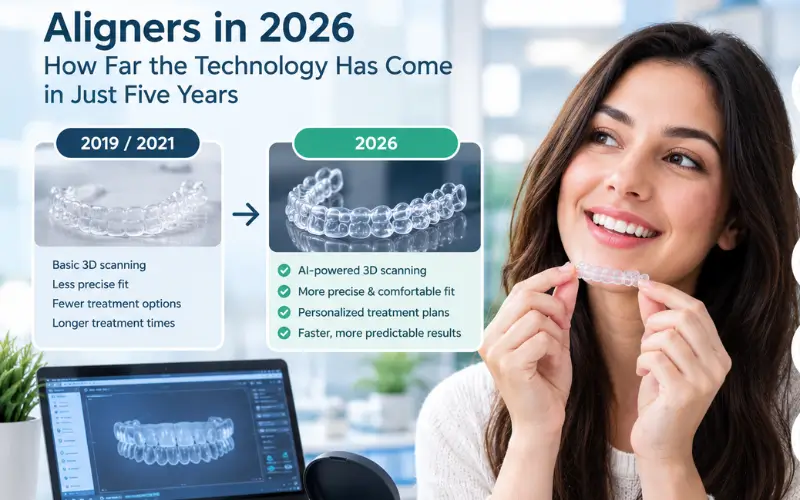
Five years ago clear aligners were very much in vogue. People knew what they were, clinics were selling them and the whole concept of straightening teeth without the use of metal wires was well and truly established (it’s been around for over 20 years). The technology in the aligners in 2021 is not the same as the technology in the aligners in 2026.
The changes have been so gradual that most people have not noticed them at all. If you looked at aligners a few years ago and concluded they weren’t for you, the current offering may well be the one that convinces you. This article looks at the specific advances that have taken place and what they actually mean in practice.
Where Aligners Were in 2021
In 2021 aligners were very effective for mild to moderate cases of crowding and spacing. The dentists would take either a digital scan or in some clinics a physical impression to create a model of the patient’s teeth. Treatment planning software was available but it was very limited in its ability to predict how the teeth would actually respond to the force of each tray.
Refinement trays were the norm. These were additional sets of aligners produced part way through treatment to correct movements that hadn’t gone quite as planned. Patients frequently ended up with more trays than they’d originally anticipated which naturally extended the length of their treatment.
Materials were also limited. Most of the aligner brands used a single type of thermoplastic and the force that was applied was pretty much the same whether you were moving a tooth a lot or a tooth a little.
3D Scanning Replaced Messy Impressions
One of the most obvious things for the patient is the way the impressions are taken. In 2021 many clinics were still using the traditional physical impression trays with the putty in them. The patient would have to bite down and hold their position while the putty set. It was an uncomfortable experience and the accuracy of the impression was entirely dependent on how well the putty had actually captured the detail of each tooth.
Today intraoral scanners have pretty much replaced that process. You’ve got a small handheld device which takes thousands of images per second as it moves around your mouth to build up a very accurate 3D model in real time. The scan itself takes a few minutes, there’s no gagging involved and you end up with a digital file which is vastly more accurate than a physical mould.
This is important because the quality of the initial scan will have a direct bearing on how well each aligner tray fits. A better scan leads to better trays, fewer refinements and a far smoother treatment.
Smarter Software, More Predictable Outcomes
Treatment planning software has come a long way. The software that dentists use today is capable of simulating tooth movement with far greater accuracy than in the past, taking into account root form, bone resistance and the biomechanics of how teeth respond to sustained pressure.
The old software would give you a visual of what the result would look like but it wasn’t always able to predict which movements would stall or which teeth would be resistant to movement. The new software uses the data from millions of cases that have been completed to make its predictions. The end result is a much more realistic plan from the outset.
For the patient that means fewer surprises. If your dentist is able to show you the projected outcome on screen then the final result is far more likely to be in line with that than it would have been five years ago.
Material Science Changed the Trays Themselves
The plastic in the aligners has gone through several generations of evolution. The earlier plastics would apply a burst of force when initially placed and then lose that force as the tray settled. That inconsistent force made some of the movements quite difficult.
Newer materials are designed to maintain a more constant level of force right through the full wear life of the tray. Some systems now employ variable thickness designs whereby different sections of the same tray will apply different levels of force depending on what each tooth requires.
This has broadened the scope of cases that clear aligners can be used for. Rotations, vertical movements and moderate bite corrections which previously would have been very difficult to achieve with clear aligners are now much more reliably achievable.
Remote Monitoring Between Appointments
In 2021 the vast majority of aligner patients were in the clinic every 4-6 weeks for progress reviews. The dentist would check the fit, make sure the teeth were moving as expected and hand over the next few sets of trays.
Now a number of the aligner systems have remote monitoring tools. The patient takes photos of their teeth at home via a smartphone app and the dental team look at those to check that the trays are fitting correctly. If all is well then the patient can carry on without any in person visit.
This by no means replaces the clinical check-ins. The dentist still needs to see you from time to time for the actual hands on assessment. The benefit is that it reduces the total number of visits required though which is obviously a massive time saver for patients with very busy lives or those who live a long way from the practice.
Faster Treatment Timelines for Many Cases
Improvements in materials, software and scanning have all had an effect on the length of treatment. A fairly crowded case in 2021 might have taken 14-18 months. The same type of case today would typically be finished in 10-14 months (again dependent on patient compliance and the complexity of the bite).
Fewer refinement stages make a big difference here. If the initial plan is more accurate and the trays maintain a better level of force consistency then the teeth will track much closer to the predicted path. That in turn means less backtracking and fewer trays.
Of course every case is different. Complex bite corrections will still take time and treatment duration is always going to be dependent on wearing the aligners for the recommended 20 to 22 hours a day.
What This Means for You as a Patient
If you looked at clear aligners previously and ruled them out then it’s definitely worth looking at them again. The trays are far more comfortable, the planning is much more accurate, the scanning is quicker and the materials are far more consistent than they were five years ago.
It also means the range of cases that can be treated has increased. Conditions which previously would have required braces or a combination of treatments can now potentially be managed with aligners alone. The only way to be sure is to have your case looked at by a dentist who is experienced in the use of the current aligner systems and who can then tell you what the technology is capable of and what it isn’t for your individual situation.
Conclusion
Aligner technology in 2026 is not the same product as it was in 2021. It’s not a marketing exercise, it’s not a superficial upgrade in any way. It’s a genuinely improved product across the board from the initial scan and treatment plan through to the tray materials and monitoring. It’s all about the functionality of the product and the impact that has on the treatment itself in terms of efficacy, duration and comfort. If you’ve been thinking about aligners then this is a very sensible time to have that conversation with a dentist who can go through the current range of options with you.
Contact Us
Magnum Dental Clinic, DSO SIT Tower 101, next to Choitram Super Market, above Baskin Robbins ice cream, Dubai Silicon Oasis, Dubai, United Arab Emirates. Phone: +971 54 336 3340
Also read:
Ousha Al Suwaidi: The Poetry and Traditions of the UAE