


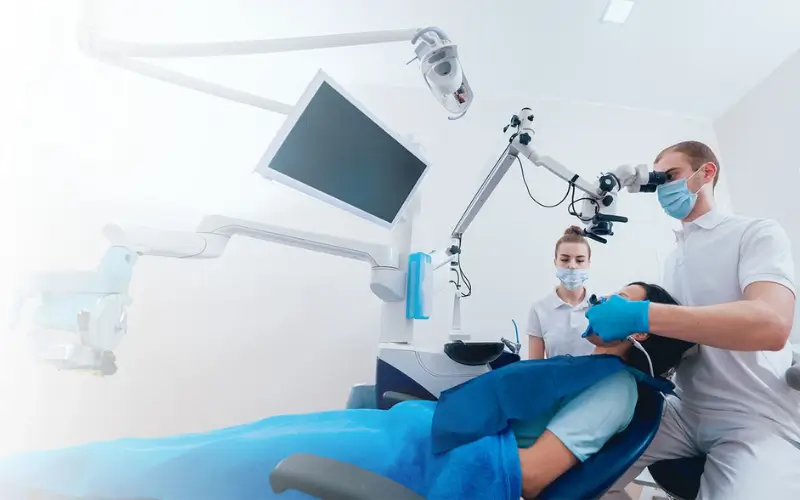
Whenever we consider the issue of oral health, what comes to mind is a check-up at the dentist or a wide smile. But dentistry is much more than that. It is a complex structure of hard and soft tissues that assist us in breathing, talking, biting, and speaking. A connection between the current dentistry and Oral and Maxillofacial Surgery (OMFS) is one of the most developed spheres of this field. This specialty combines dental care with surgery to overcome the diseases of the mouth, jaws, face, and neck.
The Scope of Maxillofacial Expertise
Maxillofacial surgery is a speciality of its own. It involves a practitioner having a degree in dentistry as well as medical-surgical training. This combined expertise will permit the treatment of too complicated conditions that a general dentist cannot treat and too specialised that a general surgeon cannot treat. The range of treatment extends to the correction of the affected third molars (wisdom teeth) up to a more complex reconstructive surgery after a facial trauma.
In the bustling healthcare landscape of the Middle East, patients often seek the specialised care found at a premier Dubai dental hospital. They combine several sub-specialties, such as orthodontics, periodontics, and prosthodontics, with maxillofacial surgery in order to deliver comprehensive care. Be it a patient with a congenital defect, such as a cleft lip or a functional problem such as obstructive sleep apnoea, the treatment is always multidisciplinary.
Advanced Diagnostic Modalities
The modern maxillofacial care is characterized by precision. Surgeons are no longer dependent on two-dimensional X-rays or the sense of touch only. The introduction of Cone Beam Computed Tomography (CBCT) has transformed the diagnostic stage. CBCT can give high-resolution 3D images of the craniofacial structure, and with much less radiation exposure compared to traditional CT scans.
These computerized replicas enable the surgeons to trace the precise location of the mandibular nerve before an extraction or to determine the bone density of the alveolar ridge before the placement of a dental implant.
Corrective Jaw Surgery (Orthognathic Surgery)
Orthognathic surgery is one of the life-changing processes in this area. It includes jaw surgery to reposition the maxilla (upper jaw) or mandible (lower jaw) to correct skeletal discrepancies. Although most of the patients may initially pursue this treatment due to cosmetic reasons like fixing a receding chin or a smile grimace, the practical advantages are the most important.
Misaligned jaws may result in:
- Persistent Temporomandibular Joint (TMJ) pain.
- Difficulty in chewing food (malocclusion).
- Speech impediments.
- Problem with breathing at night.
Surgeons reestablish the balance between the teeth and the skeletal structure by making the bones of the face match. Not only does this increase the symmetry of the face, but also the natural dentition lasts longer since the forces used in biting are evenly distributed. We witness patients who have had lifelong difficulties with bites relieved instantly with only one corrective surgery.
Dental Implants and Bone Grafting
Loss of a permanent tooth is not just a cosmetic issue, but rather a process called resorption, whereby the jawbone beneath the tooth begins to shrink because of the absence of stimulation. To prevent this loss of bone, dental implants, which are biocompatible titanium posts, are used to substitute the root of the tooth by maxillofacial specialists.
But when a patient has lost a tooth long enough, there might be insufficient bone to hold an implant. Here is where an augmentation of bones or grafting is needed. The surgeon reconstructs the foundation of the jaw using the patient’s own bone of the patient (autogenous graft) or a modern synthetic material. Such advanced procedures will help to restore full oral functions and confidence in even patients who have a considerable amount of bone loss. It is indeed quite astonishing how the science of today enables us to reconstruct the foundations of a person’s face.
Managing Facial Trauma and Pathology
Our identity is based on the face, and thus, facial trauma is especially traumatizing. Maxillofacial surgeons are the first responders in cases of facial injury, soft tissue injury, and dental injuries that are the products of accidents. They have a twofold objective to restore the functioning (including the opening of the mouth) and to reduce scarring.
Besides injury treatment, oral cancers and non-cancerous cysts are other issues addressed in this field. It is important to spot these at an early age. Dentists tend to be the initial ones to point out the presence of something abnormal in their regular check-ups. In case the tests reveal that one has cancer, a maxillofacial surgeon performs the procedure to extract the cancer and reconstruct the affected part. The jaw or tongue is often replaced using tissue from another part of the body.
The Patient Experience in Dubai’s Medical Hub
Dubai has been able to position itself as a medical hub of excellence to which clinicians of the world have flocked and which has instituted strict international standards. To both residents and medical tourists, the care is of the best standards that can be found in either the UK or North America.
Well-performing facilities focus on patient comfort with the use of painless dentistry procedures and intravenous anesthetics during surgery. The accuracy of the complex reconstructions has been further enhanced by the incorporation of Artificial Intelligence (AI) into radiology and the application of 3D printing to create surgical guides.
This commitment to innovation ensures that patient outcomes are consistently superior. When you walk into a clinic here, you aren’t just getting a treatment; you are accessing a global network of medical knowledge. Besides, when visiting a top-tier hospital in Dubai, patients benefit from this “digital workflow,” where virtual surgical planning ensures that the actual procedure is minimally invasive and highly predictable.
Conclusion: A Foundation of Health
The interaction between the field of dentistry and maxillofacial surgery is the epitome of an art-science marriage. It is a science that is focused on the replacement of what time, trauma, or genetics might have removed. With regular check-ups with a trained dentist and obtaining expert treatment in case of skeletal or pathological complications, people can make their oral health a strong support of their overall health.
It doesn’t matter whether you need a regular restoration or a complicated surgical procedure; the skill that is currently present will make sure that your path to health is safe, accurate, and life-altering. The contemporary medical environment provides the way towards a pain-free and functional existence, which is backed up by the most sophisticated technology humankind has to offer. These changes are happening on a daily basis, and they will always be an inspiration.
Must Visit: Mina Rashid DPI Test
Okta Etihad | Advancing Cloud Identity and Access Control in Modern Aviation Systems
Etihad Okta Login Guide for Employees and Staff Access


