
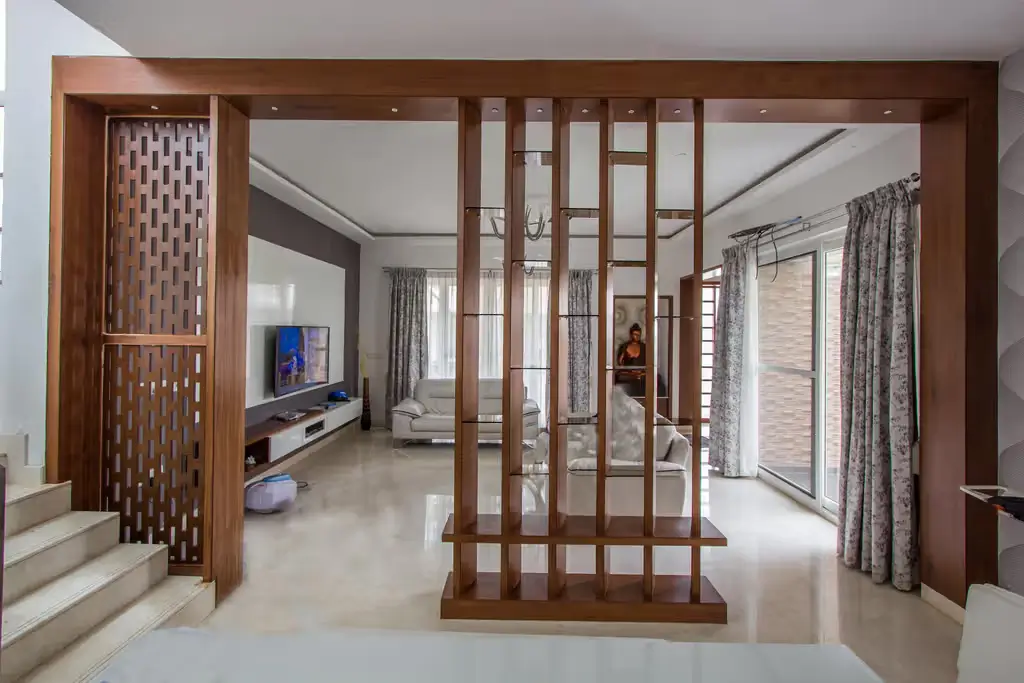
Few housing formats in Dubai attract as much debate as the partition. Regulators have repeatedly cracked down on illegal subdivisions, safety campaigners point to blocked windows and overloaded wiring, and yet demand never seems to disappear. Search activity for partition rooms in Deira and similar older districts stays strong year after year. To understand why, it helps to look at the format the way an economist would: as a market that keeps clearing because both sides of the transaction keep finding it worthwhile.
A price gap that never closes
The core driver is simple. A partitioned room typically rents for 25 to 35 per cent less than a private room in the same building. That gap has proved remarkably stable across market cycles.
| Area | Partition (monthly) | Private room, same building (monthly) | Gap |
| Deira | AED 1,600 | AED 2,300 | 30% |
| Bur Dubai | AED 1,700 | AED 2,400 | 29% |
| Al Nahda | AED 1,500 | AED 2,100 | 29% |
| Karama | AED 1,650 | AED 2,350 | 30% |
Treat these as typical figures rather than fixed prices. Rates vary by building and by how the partition is built, so confirm the exact monthly cost for the specific unit.
For a tenant earning AED 4,000 to 6,000 a month, AED 700 is not a rounding error. It can be the difference between saving and not saving, or between sending money home and not.
Who rents partitions, and what they’re optimising for
Partition tenants are not a single group. They include early-career professionals who want a door that locks but cannot yet afford a full room, couples who want privacy on a single income, and workers who spend most of their waking hours at the job and need a quiet place to sleep near a metro station.
What unites them is a clear priority order: location first, privacy second, space a distant third. A partition in Deira, close to the Red and Green Lines, can beat a full room in a distant suburb on every measure that matters to these renters.
The landlord’s side of the spreadsheet
For the person holding the main lease, the economics are equally clear. A two-bedroom flat divided into four or five lettable spaces can generate considerably more total rent than the same flat let as two rooms. Even after furnishing, fitting and higher maintenance, the yield difference keeps the format attractive.
This is also where the risk lives. When the subdivision is done without approval from the building management and Dubai Municipality, or without proper fire-rated materials and ventilation, the higher yield is effectively borrowed against the tenants’ safety and security of tenure.
Deira as a case study
Deira shows why the format is so persistent. The district combines older, larger floor plans that subdivide easily, excellent metro access, thousands of nearby jobs in trading, retail and hospitality, and some of the lowest day-to-day living costs in the city. Every one of those factors pushes demand towards affordable, central, private-ish space. The partition is the market’s answer.
What would actually reduce demand
Enforcement alone tends to move the market rather than shrink it: when inspections close units in one building, demand shifts to the next. Lasting change would come from the supply side, through more purpose-built, affordable small units near transport, such as licensed co-living buildings and compact studios priced for the AED 4,000 to 6,000 salary band.
Until that supply arrives, partitions will keep filling a real gap. For tenants, the practical lesson is to treat the price gap as only half of the decision. Before paying a deposit, ask to see written confirmation that the partition is approved, check that your space has a window and a clear exit, and confirm the main tenancy is registered with Ejari. A cheaper room is only good value if you can stay in it.