
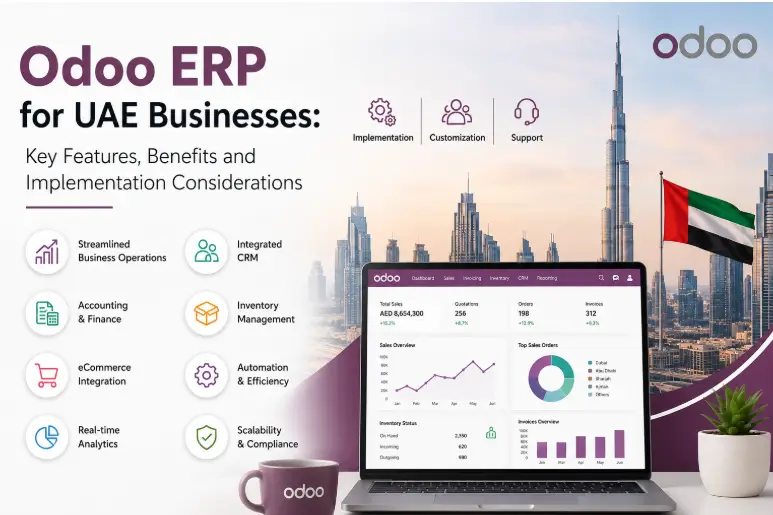
The UAE is one of the most competitive and digital markets in the world, where businesses are operating. Businesses in Dubai and throughout the UAE are working hard to become more efficient and provide improved customer experiences from retail and eCommerce to manufacturing, logistics and professional services.
Odoo is an integrated business management system with multiple functions in one ecosystem. Using the applications for accounting, CRM, inventory, sales and eCommerce separately can be avoided and business can have a smoother flow of information.
But for UAE businesses looking to embark on digital transformation, selecting an ERP system is just the first step. The actual value lies in identifying the appropriate modules, setting up the workflow effectively, connecting existing systems and making sure that the employees can use it correctly.
Businesses often struggle to manage and coordinate finance, inventory, sales, customer relationships, and operations with unconnected systems as they grow. Odoo development company in Dubai come into play here to build a more integrated and scalable tech landscape for businesses.
Why Odoo Is Gaining Attention Among UAE Businesses
Dubai is now an important hub for entrepreneurship, retail, logistics, technology and international trade. With this growth comes the need for more complicated operational requirements.
A growing business may need to manage:
- Multiple sales channels
- Different customer segments
- Inventory across warehouses
- Online and offline orders
- Supplier relationships
- Finance and invoicing
- Customer support
- Marketing campaigns
- Employee information
- Third-party integrations
Manual or unconnected management of these activities can lead to data silos and administration burden.
Odoo adopts a different approach which is to offer several business applications on one platform. Businesses can begin by creating the functions they require and later add complexity to the system as they grow in complexity.
A retailer who operates in Dubai could integrate sales, inventory, accounting and customer data, for instance. It can be used for a B2B business to handle leads, quotations, sales order, purchasing and finance in a connected environment.
Key Odoo ERP Features for UAE Businesses
1. Finance and Accounting
A growing business in the UAE will require one of the most critical financial management.
Odoo can handle the process of issuing and receiving invoices as well as payments, expenses, and accounting records from your central system. Linking finance to sales and operations data may also eliminate redundant manual data entry.
This visibility can help businesses who sell products on multiple channels better understand their revenue and expenses as well as payments that have not been received.
2. Sales and CRM Management
Teams involved in sales tend to use data in spreadsheets, email chats, and different CRM systems. This can make it more difficult to get the full picture of the customer journey.
Customer and sales activities are integrated into an interconnected environment with Odoo. Businesses can control leads, opportunities, quotations and sales orders and provide sales teams with clear visibility of pipelines.
It can be especially helpful for companies in UAE that conduct high dollar B2B transactions or customers in various markets.
3. Inventory and Warehouse Management
As businesses expand their products, their warehouses, suppliers, and sales channels, so does their inventory management.The more products, warehouses, suppliers, and sales channels that businesses add, the more complex their inventory management becomes.
Odoo can assist businesses with managing stock movements, purchases, warehouse and fulfilment processes from a single point.
For retailers and eCommerce businesses in Dubai, this can help establish a greater visibility of orders and stock. Businesses can also link the inventory workflows to sales workflows and purchasing workflows.
4. eCommerce Integration
E-commerce is still playing a significant role in sales for enterprises in the UAE.
An ERP should be able to work together with an eCommerce store. Data such as product information, orders, customers, inventory, and financial data could flow from the storefront to the back-office systems.
Odoo has eCommerce features to integrate with other business processes. This enables companies to build a more cohesive environment, instead of dealing with online operations separately.
5. Marketing Automation
Acquiring customers in Dubai is tougher than ever before.
Odoo also has features like marketing automation which can be used to send emails and segment it, as well as to automate communication with customers. With the integration of marketing activity and data on customers and sales, companies can better understand the impact of the marketing campaigns on their commercial objectives.
6. Customer Support
Customer expectations are never over after the transaction.
Odoo’s helpdesk and customer support features can aid companies in running support interactions, helpdesk tickets, and support requests properly.
Organised after-sales support can play a role in improving customer relationships in competitive sectors like retail, electronics, automotive and professional services companies in the UAE.
Odoo and the Wider ERP Strategy
It can also be used as a part of a company’s overall digital infrastructure.
In the future, businesses will want to integrate their ERP system with their eCommerce platform, CRM, accounting software and more.
Organisations can use a structured ERP implementation services process to assess workflows, make systems configurations, move data over and set up integrations prior to going live.
This is particularly relevant for businesses in UAE having a complicated supply chain or multiple sales channels or having operations at various locations.
Businesses need to think of ERP not as an application, but as part of their overall technology landscape.
What Are the Benefits of Odoo ERP for UAE Companies?
Better Operational Visibility
Having information about the business in a single connected environment is one of the greatest advantages of an integrated ERP system.
No more getting several disjointed reports from management teams regarding sales, inventory, finance and customers’ activities.
Reduced Manual Work
Often employees enter the same information more than once when there are no systems communicating.
Automation can help to minimize repetitive office tasks. For instance, sales data can be used to automatically update inventory and financial processes—this eliminates redundant manual updates.
Easier Business Scaling
A good system for a small company can become challenging when additional products, employees, warehouses or sales channels are added to the organisation.
Businesses can easily scale and configure their technology landscape with Odoo’s modular design.
It can be perfectly suited for the UAE businesses with the plans of quick expansion and growth in the other markets of the GCC.
More Connected Customer Information
Data can only be useful to customers when teams can access and utilize it efficiently.
When sales, CRM, marketing and customer support data are linked, it provides a more comprehensive view of the customer’s interactions with the business. This can help to ensure quicker responses and smoother customer interactions.
Odoo Implementation: What Should UAE Businesses Consider?
Don’t assume that purchasing an ERP system means your operations issues will be solved. The actual results of implementation make a significant difference to the outcome.
When considering an Odoo project, businesses should take into account their processes, data structure, integrations, and future growth plans.
Define Business Requirements First
The first step in selecting and configuring modules is for companies to determine their processes they wish to enhance.
Questions worth asking include:
- Which processes are currently manual?
- Where are data silos causing problems?
- Which departments need to share information?
- What systems need to be integrated?
- What reporting does management require?
- Which workflows should be automated?
This prevents businesses from implementing unnecessary functionality.
Plan Data Migration Carefully
When you implement ERP, you need to move over your existing customer, product, inventory, financial and operational data.
After live, poorly structured data may cause issues. Hence, companies should clean the data, map it, validate it and test it prior to migration.
It’s especially crucial for businesses that have transitioned away from spreadsheets or a number of legacy systems.
Consider Integrations
Most established businesses already use several digital tools.
An Odoo environment may need to communicate with:
- eCommerce platforms
- Payment gateways
- Accounting systems
- Shipping providers
- Marketplaces
- CRM platforms
- Marketing tools
- Warehouse systems
Integration planning should therefore happen early rather than being treated as an afterthought.
Prioritise User Adoption
If employees don’t know how to use it, no matter how good the ERP system is, it will fail.
The process of implementation should include training, documentation and user testing. Key workers should also be engaged in the design of workflow, as the design should be based on the actual way teams work.
How Odoo Development Services Support Complex Business Requirements
While some companies can make do with standard ERP features, certain businesses may need to customize or build new features to accommodate their specific processes.
This is where Odoo development services come in handy.
Businesses can use specialist development teams to tailor modules, add extra functionality, connect with third party platforms, move data and adjust workflows to their needs.
A UAE retailer might be looking for a tailored inventory process, for instance, or a B2B distributor might need specialized quotation, approval or pricing processes.
The aim shouldn’t be to “personalise” everything. Rather, businesses should make a determination of where they can gain value from the standard functionality and where they can gain value from custom development.
The Role of CRM in an Odoo-Connected Business
ERP helps to handle business processes that are internal to any enterprise, but external business processes must be managed as well.
A CRM system can be used to handle leads, opportunities, customer data and follow-ups for sales and marketing teams. Integrating CRM and ERP processes enables easier flow of customer and transaction data between commercial and operational teams.
For organizations having intricate sales cycles, CRM implementation services in Dubai can be utilized to match pipelines, automation, integrations, reporting and customer data with genuine business procedures.
This can be particularly valuable for UAE companies where sales teams, marketing departments, customer service teams and finance departments need access to consistent information.
How UAE Businesses Can Prepare for Odoo Implementation
Businesses considering Odoo should take a structured approach rather than attempting to transform every process at once.
A practical implementation roadmap can include:
- Audit current processes
Identify operational bottlenecks, manual tasks and disconnected systems. - Define priorities
Determine which departments and workflows should be addressed first. - Select relevant modules
Choose functionality based on actual business requirements rather than implementing every available feature. - Prepare data
Clean and organise customer, product, inventory and financial information before migration. - Plan integrations
Identify the external platforms and services that need to connect with Odoo. - Configure and customise
Adapt workflows where standard functionality does not fully support business requirements. - Test before launch
Use realistic business scenarios to identify issues before going live. - Train employees
Ensure users understand their workflows, responsibilities and system capabilities. - Monitor performance
Continue improving workflows and automation after implementation rather than treating go-live as the end of the project.
Is Odoo Right for Your UAE Business?
Odoo can be a strong option for UAE businesses looking to bring different operational functions into a connected environment. However, the right ERP choice depends on company size, industry, existing technology, operational complexity and growth objectives.
A small business may only need a few modules initially, while a larger organisation could require extensive integrations, custom workflows and advanced automation.
The key is to focus on business requirements rather than choosing an ERP simply because it offers a large number of features.
For companies operating in Dubai and the wider UAE, the implementation strategy should also account for local operational requirements, financial processes, integrations, data management and future regional expansion.
Final Thoughts
By fostering streamlined operations and driving sustainable growth, ERP systems are becoming an integral part of the backbone of UAE businesses as they become more digitally connected.
Odoo provides a wide range of applications for companies in areas such as finance, sales, customer management, inventory, eCommerce, marketing, and customer support. Depending on the stage of growth that businesses are in, the modular nature can make it an appropriate choice for them, if the system is planned and implemented correctly.
Odoo development services can be tailored to meet specific business requirements, offering customization, integration, and technical expertise for organizations with more complex needs.
Finally, ERP transformation isn’t just about the software. It’s all about designing processes that are connected – enabling people to work more efficiently, management to be more visible and the flexibility to keep up with the changing UAE market.