


The logistics industry in Saudi Arabia is growing at a rapid pace, and modern warehouses and large distribution centres are being developed to support expanding retail, e-commerce, and manufacturing supply chains. As the size of the facilities increases, the demand for energy also rises. Lighting, material handling equipment, storage, and conveyors consume energy throughout the day inside the warehouse environments.
The move towards sustainable warehousing is forcing DC operators in Saudi Arabia to take a hard look at the automation systems in operation within their facilities, particularly at the energy consumption patterns of these systems and whether better options are available. The answer lies in purpose-built, energy-efficient automation technology designed specifically for modern warehouse environments.
Why Is Shuttle-Based ASRS Central to an Energy-Efficient Warehouse?
Pallet shuttles and multi-level carton shuttles function in fixed aisles and lanes, making accurate short-cycle movements that consume a fraction of the energy consumed by forklifts in travelling, lifting, and idling on a DC floor.
For Saudi Arabian distribution centres with high SKU volumes in temperature-controlled environments, every degree of reduced heat generated by storage equipment translates into lower cooling costs, making shuttle-based ASRS a sensible starting point for energy-saving initiatives. This is ideal for them since they will be able to make their facilities green distribution centers.
How Do AMRs Support Demand-Responsive Green Warehousing?
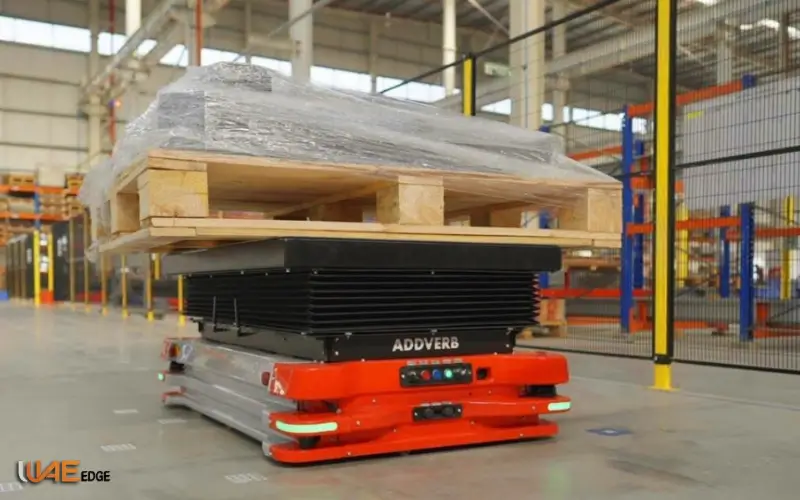
Autonomous mobile robots enable green warehousing by transporting products across the DC floor on lithium-ion batteries along optimal routes calculated in real time. Unlike fixed conveyor routes that operate at maximum speed regardless of demand, AMRs return to charging points during low-activity periods.
Autonomous Mobile Robots (AMRs) such as Addverb’s Dynamo support energy-efficient warehouse operations by optimising movement and reducing unnecessary power consumption.
In the Saudi Arabian DCs handling mixed retail and e-commerce order profiles, energy use goes up and down with actual workload as opposed to operating at a constant baseline throughout.
How Do Zone-Controlled Conveyors and Sortation Improve Energy-Efficient Warehouse Design?
Conventional belt conveyors operate continuously, whether or not there are products on the belt. The latest conveyor technology built for energy-efficient warehouse design employs zone-controlled motors that turn on only when a box is detected and turn off immediately after.
Sortation systems with variable-speed drives operate on the same principle: varying motor output to match the rate of live induction rather than maintaining peak capacity throughout the entire shift.
How Does Regenerative Braking in Vertical Lifts Enable Eco-Friendly Warehousing?
Vertical lifts and crane-based ASRS systems use regenerative braking to turn the kinetic energy of descending loads back into usable electrical energy.
In Saudi Arabian DCs, where there is frequent vertical movement between multiple storage levels, the total amount of energy recovered over thousands of cycles per day makes a difference in carbon output.
How Does WES-Driven Task Scheduling Function as Green Automation Technology?
The efficiency of automation hardware is only as good as the software that controls it. Green automation technology at the software level means WES platforms that orchestrate tasks across robots, conveyors, shuttles, and sorters to provide quantifiable energy savings. Essential capabilities that directly impact energy reduction include:
- Preventing simultaneous peak loads by staggering equipment activation across the shift
- Automatically powering down idle systems during planned low-activity windows
- Batching movements to reduce the total number of active equipment cycles
- Flattening power demand curves to lower peak tariff charges in Saudi Arabian facilities
Equipment-Level Energy Monitoring Through the WES
More advanced WES platforms are capable of delivering real-time energy consumption information at the individual equipment level. DC managers in Saudi Arabia can leverage this information to identify which systems are consuming excessive amounts of power and monitor sustainability performance, making it easier for companies to ensure energy-efficient warehouses.
How Addverb Powers Energy-Efficient Distribution Centres
Addverb is also a proponent of eco-friendly warehousing by offering automation solutions for distribution centres that need to perform well and also be energy efficient. The company’s product offerings include autonomous mobile robots, pallet and carton shuttle systems, vertical lifts, zone-controlled conveyor systems, robotic sortation, and a proprietary warehouse execution system that integrates all these solutions.
Addverb’s solutions are specified with energy efficiency integrated, such as variable-speed drives, regenerative braking on vertical machines, demand-responsive AMR fleet management, and WES-level energy scheduling. For Saudi Arabian-based operators developing green distribution centres in line with sustainability goals, Addverb provides automation solutions that consume less energy without affecting productivity.
Conclusion
Choosing the appropriate DC automation solutions is one of the most important choices that a Saudi Arabian logistics company can make. ASRS shuttles, AMRs, zone-controlled conveyors, regenerative vertical lifts, and intelligent warehouse execution software all play a significant role in minimising energy usage. They collectively determine what constitutes a truly energy-efficient distribution centre.
Addverb offers all these solutions in one place, providing Saudi Arabian logistics companies with a clear and viable path to sustainable warehousing.
Must Visit: Etisalat Top Up: Complete Guide to Recharge Easily
Etisalat Quick Pay Instant Bill Payment & Recharge Guide for UAE Users
Souq Extra Silicon Oasis Complete Shopping Guide for Electronics and Home Appliances


