
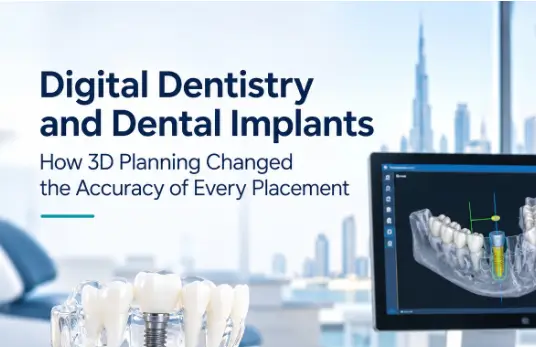
What Is 3D Planning in Dental Implant Treatment?
If you have been reading about dental implants, you have probably come across expressions such as CBCT scans, digital workflow, and guided surgery. These are not marketing buzzwords. They represent a real change in how dentists plan and place implants today.
A decade ago, dental implant treatment relied heavily on two-dimensional X-rays and the dentist’s hands-on experience during surgery. That approach worked, but it had limitations. The dentist could not always see the full picture of what was happening beneath the gum line, including bone density, nerve positions, and sinus proximity.
3D planning changed that. It gave dentists a complete, three-dimensional map of your jaw before they even pick up a drill.
How It Used to Work vs How It Works Now
Traditional dental implant treatment followed a more manual path. The dentist would take a panoramic X-ray, assess the available bone visually, and make placement decisions during the surgery itself. There was always a degree of estimation involved.
With digital planning, the process looks very different. Before your dental implants are placed, your dentist captures a CBCT (Cone Beam Computed Tomography) scan. This scan produces a detailed 3D image of your entire jaw, showing bone volume, bone quality, the exact location of nerves, and the position of neighbouring teeth.
Using specialised software, the dentist can then plan the angle, depth, and position of each implant on screen, long before the actual procedure begins. This leads to fewer surprises during surgery and a treatment plan built specifically around your anatomy.
What Happens During CBCT Scanning
A CBCT scan is quick and simple. You stand or sit in front of the machine while it rotates around your head for about 20 to 40 seconds. There is no pain involved.
The scan produces hundreds of sectional images that the software assembles into a full 3D model of your jaw. Your dentist can rotate, zoom, and slice through this model from any angle.
For dental implants, this level of detail is important because even a millimetre of misplacement can affect how the implant integrates with the bone, how the crown sits on top, and how comfortable the final result feels in your mouth.
How Digital Planning Improves Placement Accuracy
When your dentist plans dental implant treatment digitally, several things improve at once.
Bone assessment becomes precise. Instead of guessing bone density from a flat X-ray, the dentist measures it directly in 3D. This helps in deciding whether you need bone grafting before implant placement or whether the existing bone is sufficient.
Nerve mapping reduces risk. The inferior alveolar nerve runs through the lower jaw, and damage to it during surgery can cause numbness. 3D planning shows the nerve’s exact path so the dentist can keep a safe distance.
Implant angulation is pre-decided. The software lets the dentist choose the accurate angle for each implant, factoring in how the final crown or bridge will sit. This is especially useful when placing multiple dental implants or when bone is limited in certain areas.
Prosthetic planning happens first, not last. In a digital workflow, the final restoration (the visible tooth) is designed before the implant goes in. This “prosthetically driven” approach means the implant is placed where the tooth needs to be, not just where the bone happens to be easiest to access.
Guided Surgery and What It Means for You
One of the most practical outcomes of 3D planning is guided surgery. Once the digital plan is finalised, a surgical guide is fabricated. This is a custom-made template, usually 3D-printed, that fits over your teeth or gums during the procedure.
The guide has small holes drilled at the exact angle and position planned on the software. During surgery, the dentist drills through these holes, which means the implant goes exactly where the plan says it should.
For patients, guided surgery often means shorter procedures, less tissue handling, and a more predictable recovery. For complex cases involving multiple dental implants, it can be the difference between a smooth dental implant treatment and one that requires mid-surgery adjustments.
Who Benefits Most From This Approach
While digital planning benefits nearly every implant patient, some cases see an especially significant advantage:
- Patients with limited bone who need careful positioning to avoid grafting or to work around anatomical structures.
- Patients replacing multiple teeth where alignment between implants needs to be precise for the final bridge or denture to fit properly.
- Patients with medical considerations such as diabetes or controlled bone conditions, where minimising surgical time and tissue trauma supports better healing.
- Nervous patients who feel more comfortable knowing the procedure has been mapped out in detail before it begins.
Conclusion
Digital planning and 3D imaging have changed how dental implants are placed. The guesswork that once accompanied dental implant treatment has been replaced by detailed, patient-specific planning that accounts for bone structure, nerve positions, and final tooth design before surgery begins.
If you are considering dental implants, ask your dentist whether they use CBCT scanning and guided surgery. It is a reasonable question, and the answer tells you a lot about how your treatment will be planned.
Contact Us
If you are in or around Arjan and looking for a dental team that uses digital planning for dental implant treatment, we would be glad to welcome you.
Magnum Dental Clinic – Arjan
Building 88, Al Barsha South, Near Miracle Garden, Arjan, Dubai, United Arab Emirates
Phone: +971 55 890 8653